À propos
Troyes, where the heart beats stronger !
“Troyes: the city of romance”, a stroll through a passionate city
With its multi-coloured rows of timber-framed houses huddled closely together, its maze of narrow streets, alleyways and hidden passages perfect for stealing a kiss, its history which lives on today on every street corner, its chain of Romanesque and Gothic churches, its public parks and gardens with their old-worldly charm, its medieval-style shops, its old city centre shaped like a champagne cork, it’s long-lost canal and its twisting, turning river, Troyes is a city bursting at the seams with romanticism. It’s the perfect place for the pure of heart and the sensitive of spirit to come and experience for themselves… and, of course, to fall in love with. Although this guide hardly touches the surface in terms of what the city offers, we hope it will help to seal this loving bond.
Romanticism for everyone!
Does it really matter whether angels are male or female? Whatever gender they are, they are angels just the same...
Troyes is a place where romanticism is accessible to everyone.
The city makes no distinction based on personal preferences or inclinations.
It’s a city where Love is written with a capital L, where all of the colours of the rainbow come together. It is a place where every lover will feel at home, and a place that should find a home in every lover’s heart.
Troyes is an inclusive, open and welcoming place to all followers and devotees of love, with a heart big enough to carry the emotions of all its children.
Itinéraire
Romancing Troyes
Points d'intérêts
1 - Saint- Jean-au-Marché Church

King Louis X, a member of the Capetian dynasty, was the first royal to choose Troyes as the location for his nuptials. Louis the Quarreller, son of Philip IV (Philip the fair), married Clementia of Hungary, daughter of Charles Martel of Anjou, on 1 August
1315 at Saint-Lyé near Troyes. Accounts suggest that a few coins were thrown as alms as the guests left Mass, triggering a mass fight between the po-
verty-stricken recipients. This was a gruesome pre- monition: the king died two months later at the age of 26 and his son, born after his death, also passed away just a few days old.
on 2 June 1420, henry V of England, son of henry IV, married Catherine of Valois, daughter of Charles VI of France (known as Charles the Mad) and Isabeau of Bavaria, at Saint-Jean-au-Marché church 14 .
shortly afterwards, on 13 May 1423, Troyes hosted the marriage of Anne of Burgundy, daughter of John the fearless, Duke of Burgundy and Margaret of Bavaria, to John of Lancaster, Duke of Bedford, son of henry IV of England.
2 - Place de la Libération

The square has been known as Place de la Libération since 1944, and the reason is obvious. But it would be nice to think that the local councillors of the time also wanted to pay homage to the sculp- ture in the Jardin de la Préfecture. The sculpture depicts a kidnap scene, in stunning bright white that reflects the burning desire of the protagonist. It shows a man kidnapping a woman, both nude. Le rapt depicts a merman abducting a naiad. In other words, it symbolises a marine god carrying a nymph away to his watery kingdom. This daring iconography can be interpreted as an allegory of passion, an ode to the all-encompassing power of love, or even a challenge to accepted convention. Beneath the marble shell of the statue beats a heart filled with emotion. It now takes pride of place in the middle of its own little lake in a fully redesigned garden. The two stone lions that stand behind the golden gates of the Préfecture building continue to hide their master and mistress from prying eyes, as they remain forever locked in the fervour of their irrepressible passion
3 - Rue de la Monnaie et la rue Jaillant- Deschaînets

Lovers who want to express their love under the gaze of humanity’s first couple, Adam and eve, can do so at the corner of Rue de la Monnaie and Rue Jaillant-Deschaînets. The lovers are depicted here as two statuettes carved into the wood.
4 - Museum of Modern Art - Currently closed for renovations

This symbol of eroticism stands in the middle of a garden with no flowers, other than the flowers that bloom inside the viewer’s heart.
5 - 18 de la rue de la Madeleine

Whether you have taken an oath of chastity or you want to bless your union with a symbol of fertility, you’ll find a Virgin Mary with child at 18 Rue de la Madeleine.
6 - 17 de la place Jean-Jaurès

The Virgin Mary makes a first appearance at 17 Place Jean-Jaurès, next to a depiction of St Pantaléon, sadly decapitated through carelessness.
7 - Ruelle des Chats
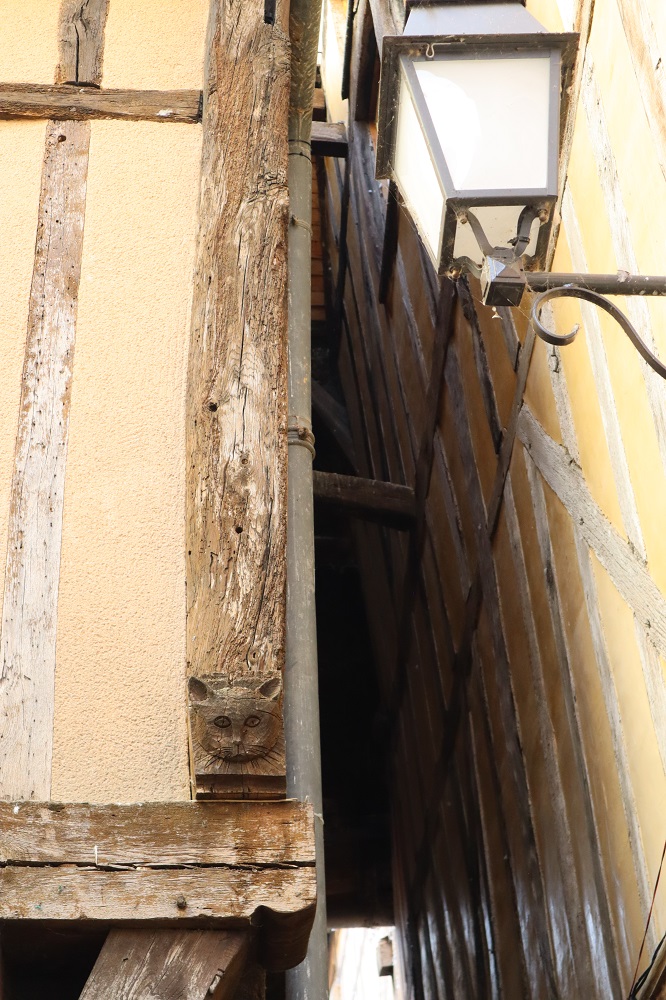
It’s not only humans that feel love for one another; houses can also display their reciprocal passion. This mutual love is perfectly encapsulated in Troyes. you may be surprised to see some grand old buildings demonstrating their attraction to each other, forged over the ages, on the corner of Rue des chats and Rue champeaux
8 - Rue Larivey

9 - Le jardin de la Vallée suisse

Every so often, you come across a city with a dream.
Some cities are destined to be commoners, others to be royalty. Once upon a time, Troyes had a dream: “I want to be a place where people can breathe clean air, where serenity, charm and pleasure abound.” or, in the words of Charles Baudelaire in his poem “L’Invitation au voyage” [Invitation to travel]: “Là, tout n’est qu’ordre
et beauté, luxe, calme et volupté [There all is order, naught amiss / comfort and beauty, calm and bliss].”
From this dream rose the Jardin de la Vallée suisse, at a time when Switzerland embodied the ideal of perfection. In 1860, the city was mourning the passing of its defunct fortifications. However, the decision-makers at the time had the foresight to preserve part of the ancient moat and create a series of four public gardens, which the locals came to call their “little gardens”. The Jardin de la Vallée suisse is a place where all nationalities are welcome, where people can come to stimulate the senses and express their feelings. Is there any place where the heart beats stron- ger than here? Intertwined on the wooden walkway that crosses the trickle of water which runs gently alongside a lawned embank- ment, beneath the protective foliage of majestic ancient trees? Sat shoulder-to-shoulder on a bench overlooking the waterfall, with its constant murmur speaking an infinite language to your soul? Or walking hand-in-hand along the undulating footpaths, at a slow pace to match the pace of life in this rural oasis? Marvel at the way in which the buildings around the gardens tower over you, until you realise you’re walking below the level of the street above...
10 - Cœur de Troyes

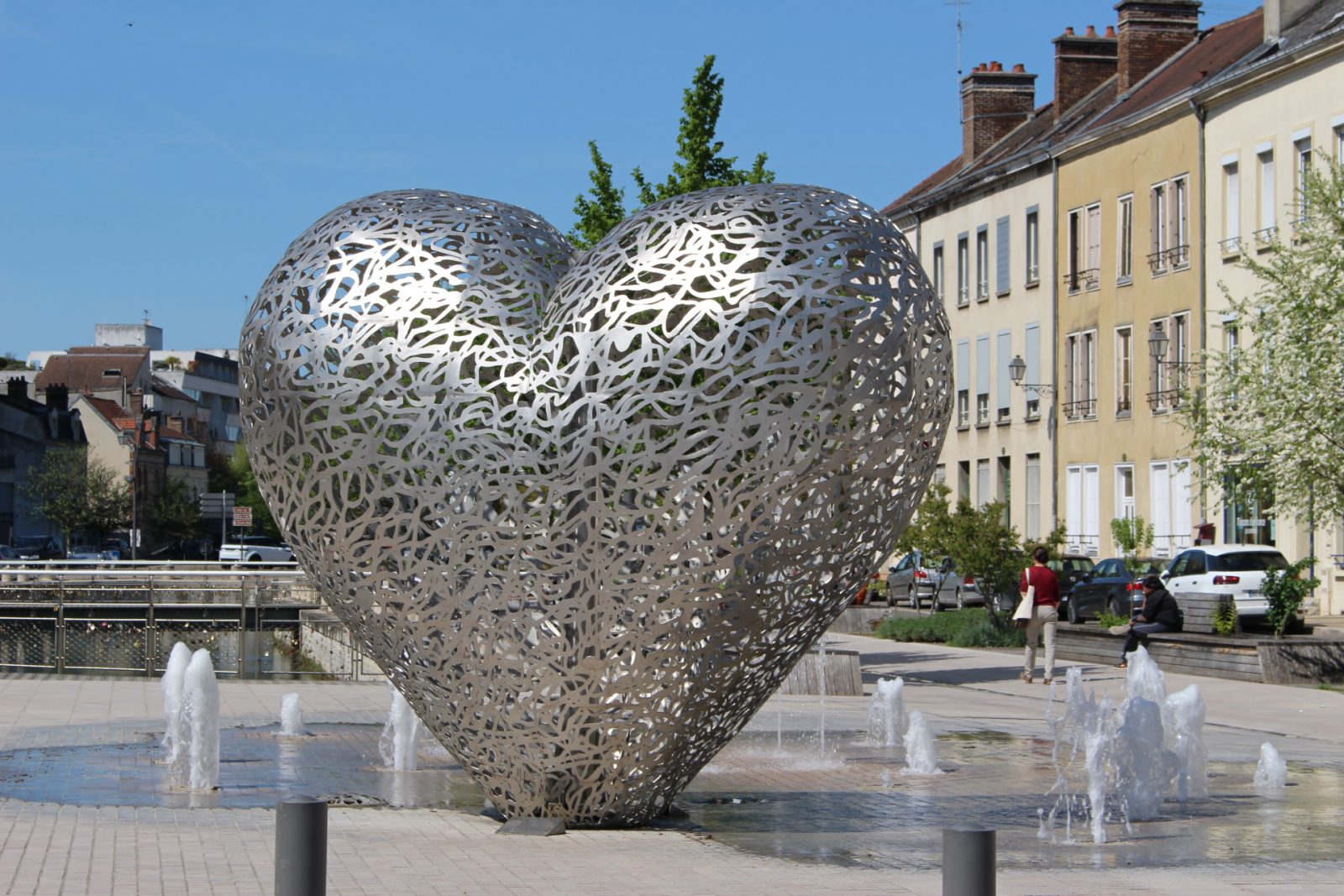
Until now, Troyes was known for its “head” and its “body”, as marked by the characteristic champagne cork shape of the old city centre.
But now, the city also has a heart. This sculpture, by a local artist, sits on the renovated quays along the old canal. This disused waterway marks the boundary between the city centre’s “head” and “body”.
This pierced heart, which beats with light at night-time, is also the heart of the city itself, both physically and metaphorically.
You’re either romantic or you’re not!
11 - L'hôtel Juvénal des Ursins

Troyes wouldn’t be Troyes without its maze of picturesque streets and alleyways. There are far too many to list here, but the pedestrian district is the perfect place for couples who want to get away from it all and enter a parallel universe. It’s a place where you’ll find the Hôtel Juvénal des Ursins, with its bright white facade like something out of a fairytale, or a tower or a natural spring straight out of the Middle Ages or the Renaissance. The city has built its own army of timber-framed houses, whose sumptuous uniforms are the brightly-coloured jewels of old Troyes.
12 - District Saint-Pantaléon (or du Vauluisant)

The saint-Pantaléon (or Vauluisant) district
is just a short walk past awe-inspiring facades rising like cliff faces from the street below, under the watchful eye of menacing gargoyles. The two stone benches beneath the trees opposite the main entrance to the church are the perfect place for a well-earned rest after this short journey.
13 - Cour Doué

14 - Rue François-Gentil

15 - Hôtel de Chapelaine

16 - Sainte-Madeleine Church

Of all the admirable churches in Troyes, Sainte-Madeleine is perhaps the oldest and certainly one of the most beautiful. Sainte-Madeleine is remarkable for its famous rood screen and the apse’s stained glass windows, a masterpiece of exceptional finesse that all visitors admire. Jean Gailde, a designer and sculptor who created the famous rood screen, is buried beneath his creation - a true testament to his love for his work.
17 - Square des Trois-Godets

17th century.
18 - The Florentine Singer
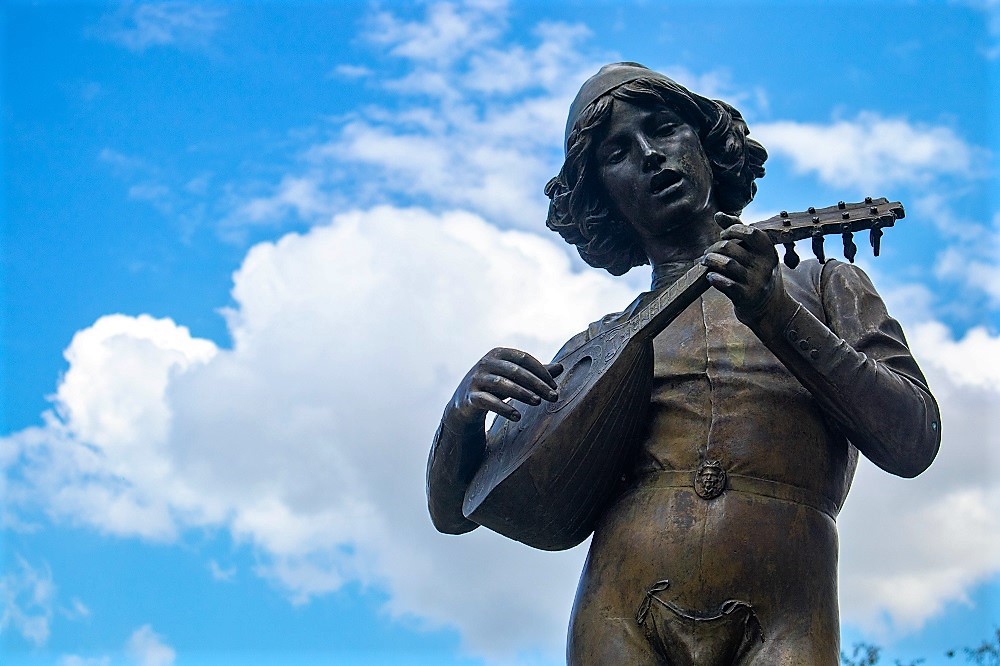
This augmented statue can be found in the square of the church of Saint-Nizier. This living work will bring you back to childhood and charm you with its music, like an arrow in your heart.
19 - Lili or the Lady with a hat

Come and stroll along the Quais de seine, just a short walk from the city centre! While you’re there, don’t forget to visit «Lili», the lady in the hat. Who knows, you might fall in love...!
You can find “Lili” sitting on a bench between Quai Dampierre and Quai des Comtes-de champagne, by Place de la Libération. She’s the lady reading a book about the counts of champagne. She’s more than happy for passers-by to take a seat beside her. This original bronze statue, standing at 1.25 metres tall, is the work of artist András Lapis.
20 - The woman giving a kiss
